National Party Positions in the 2024 Elections

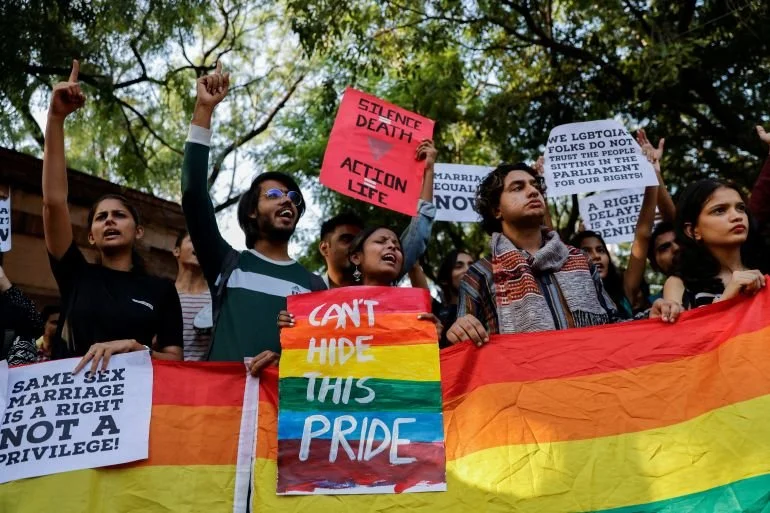
Major national parties in India hold varied positions on LGBTQ+ rights. The INC, CPI(M), and CPI actively support legal recognition of same-sex relationships and anti-discrimination measures, while the BJP opposes same-sex marriage, citing cultural concerns. The AAP has shown indirect support through its governance initiatives, and the NCP has embraced inclusion by appointing LGBTQ+ advocates. While the DMK lacks an official stance, some members support LGBTQ+ rights, and the TMC explicitly endorses same-sex marriage. These differing positions reflect an evolving but fragmented approach to LGBTQ+ issues in Indian politics.

A woman wearing a saree and holding a microphone, speaking at an event with a backdrop that has a logo and the words "The Hind".

Current Representation in Parliament

In 2022, NCP MP Supriya Sule introduced a private member bill in the Lok Sabha to legalize same-sex marriage by amending the Special Marriage Act, 1954, proposing equal legal rights for LGBTQIA couples

According to ground-breaking research done by the Pink List India, 161 of the 543 MPs elected in 2019 have publicly addressed LGBTQ+ issues as of 2023, with 116 (20%) openly supporting LGBTQ+ rights. These MPs represent a mix of rural and urban constituencies across 24 of the 37 political parties. Support for LGBTQ+ rights has grown since 2013, when few politicians opposed the reinstatement of the anti-sodomy law. However, there is a notable gap: 90 MPs back trans rights, but only 47 explicitly support queer rights. Additionally, only three parties have a clear stance on marriage equality.

The Pink List features an interactive map, enabling users to locate their MP, view their LGBTQ+ statements report card, and track commitments. Check out the Pink List here.

Marriage Equality Petition in the Supreme Court of India

The Marriage Equality Petitions in the Supreme Court of India (2023) highlighted the ongoing struggle for LGBTQ+ rights. While the Court recognized discrimination against LGBTQ+ individuals, it deferred the decision on same-sex marriage to Parliament, stating legislative action is required.

  • The Court rejected the legalization of same-sex marriage, asserting it is Parliament's responsibility to decide. Petitioners argued that legislative inaction over the past decade necessitated judicial intervention. The Court acknowledged systemic discrimination but emphasized that addressing marriage equality requires a parliamentary mandate.

  • The Court approved the government’s proposal to form a committee, led by the Cabinet Secretary, to explore legal rights for same-sex couples, such as joint bank accounts and next-of-kin recognition. Details about the committee's structure and timeline were never made public, and as of 2025 no further progress has been reported.

  • In September 2024, the Congress party formed an internal group for LGBTQ+ advocacy, appointing activist Mario da Penha as its leader. The Nationalist Congress Party named Anish Gawande, an LGBTQ+ member, as spokesperson. These steps mark significant political engagement with LGBTQ+ rights. The government maintains that decisions on same-sex marriage rest with Parliament and has sought public input for LGBTQ+ policies. However, no steps have been taken toward legislating marriage equality.

Denying marriage equality restricts LGBTQ+ individuals' fundamental rights, such as hospital visitation, joint property ownership, and adoption. It also reinforces traditional family norms, limiting recognition of alternative unions and broader equal rights for the LGBTQ+ community. Advocates stress the importance of political engagement and building broader support to mitigate potential government opposition to progressive rulings.

What we found

When we looked closely at how MPs actually talk about LGBTQ+ issues, three things stood out.

The first was how many politicians said something — but not very much. A lot of MPs, especially younger ones representing cities, would use warm, inclusive language in public. They'd show up at the right events. They'd talk about dignity and respect. But when it came to specific legislation or concrete commitments, they'd go quiet. Symbolic support turned out to be everywhere. Actual support was much rarer.

The second was that transgender rights kept coming up as a safer topic than broader LGBTQ+ rights. Many MPs who wouldn't touch questions about marriage equality or anti-discrimination law were perfectly comfortable raising questions about transgender welfare schemes in Parliament. That's not nothing — it's a foothold. And it tells you something about where political conversations can actually start.

The third was silence. A lot of MPs simply said nothing at all. At first that looks like opposition. But when we dug deeper, it usually wasn't. It was politicians calculating that there was no upside in speaking up — not yet. That's a very different problem, and it has a very different solution.

Read the full analysis on our Research page.