Practitioner Resources
Practitioner Playbook
Turning political analysis into practical engagement.
The Garv Project's Practitioner Playbook translates our research into practical guidance for organisations and individuals engaging political actors on LGBTQ+ rights in India.
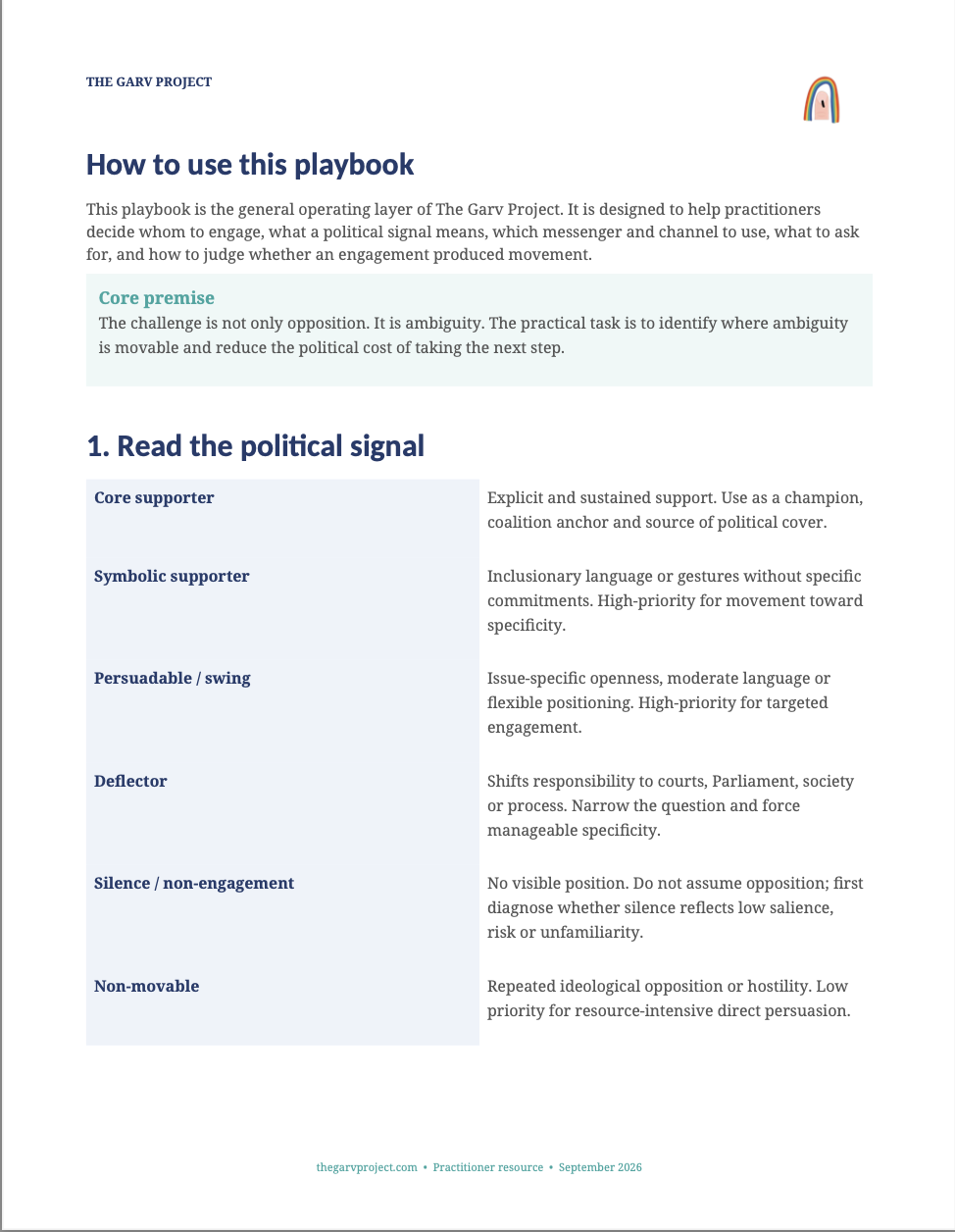
The Playbook starts from a simple premise: not every politician should be approached in the same way. A politician who uses inclusive language but avoids specific commitments presents a different opportunity from one who has never engaged with LGBTQ+ issues. And a politician concerned about political backlash may require a very different approach from one who simply lacks familiarity with the issue.
The Playbook provides a practical framework for:
identifying where political movement may realistically be possible;
diagnosing the barriers that may be preventing an otherwise receptive politician from engaging;
choosing the right messenger and engagement channel;
tailoring messages to a politician's existing interests, incentives, and constituency;
developing specific and achievable asks;
sequencing engagement from private dialogue toward more substantive positioning; and
tracking movement over time.
At its core, the objective is not to turn every politician into an LGBTQ+ champion overnight. It is to identify the next realistic step and create the conditions for movement over time.
Mapping Political Opportunity
Where should advocacy organisations focus limited time and resources?
Alongside the Playbook, The Garv Project developed a methodology for identifying political actors whose existing signals suggest potential for deeper engagement on LGBTQ+ rights.
Our analysis builds on existing political-accountability data, supplemented by parliamentary interventions, public statements, constituency and political context, and conversations with practitioners working in and adjacent to India's LGBTQ+ advocacy ecosystem.
Rather than simply identifying the most prominent supporters of LGBTQ+ rights, we looked for signals of potential movement: symbolic or inclusionary language, engagement on transgender welfare and related governance issues, moderate or rights-adjacent positioning, and other indications that a politician's position may remain fluid.
The methodology explains how we moved from a broader dataset to a smaller group of political actors warranting deeper analysis, and the principles practitioners can use to conduct similar assessments themselves.
It is not intended to rank politicians or predict individual political behaviour. Instead, it offers a more systematic way of asking:
Where is movement plausible, and where might deeper engagement be worth the investment?
For organisations considering engagement with specific MPs, The Garv Project has developed more detailed MP-level profiles and engagement considerations. These materials are not published publicly, but are available to practitioners on request. Get in touch with us if you would like to discuss a specific MP, cohort, or engagement strategy.
Why these resources matter
LGBTQ+ advocacy often operates with limited time, limited access, and limited political capital. That makes targeting as important as persuasion.
The Garv Project’s practitioner resources are designed to help organisations focus that effort more strategically: identify where movement may be possible, understand what is holding a political actor back, choose the right channel and messenger, and sequence engagement toward achievable progress.
The goal is practical: help advocates spend less time pushing against closed doors and more time identifying where political movement can actually be built.